What is ground reaction force in golf?
Ground reaction force is the force the ground returns when a golfer presses into it, and clubhead speed is created when the direction, size and timing of that force are passed in order to the torso, arms and club. It is not simply stomping down hard; what matters is when you use it, and rotation is not a cause you force but a result that appears when you use the ground and resistance well.
When should you use ground reaction force?
The moment you step into the lead foot, the pressure shift, and the order in which the torso and club respond have to line up. Open too early and the upper body and arms lag behind; too late and a hip stall occurs. Because acceleration has to be built in the 20–30 cm before impact, players feel the order of 'resistance → wait → pass through' with step, split and lead-foot drills. This timing is step 4 (linking balance and power) of golf swing speed training.
What principles are used on the lesson tee?
There are four.
- Speed starts from the ground. Head speed is created when force made by the lower body is passed in order to the torso, arms and club.
- Rotation is a result, not a cause. We do not force the turn; we let rotation come as a result of using the ground and resistance well.
- Resistance → wait → pass through. Open too early and the upper body and arms lag behind; too late and a hip stall occurs.
- No figures without measurement. Vertical, horizontal and torque components and COP movement are recorded only when there is a force plate.
What do we measure with, and what do we not say?
What we can say depends on the equipment. We do not make up GRF figures we do not have.
| Equipment | What it can confirm | What we do not say |
|---|---|---|
| Force plate | Vertical, horizontal and torque components, COP movement | — |
| GCQuad (ball and club) | Club Speed, Ball Speed, Efficiency, Path, Face, Attack Angle, Spin | Ground reaction force figures |
| Front and side video | Movements such as path estimate, space, hip stall and early extension | Ground reaction force figures, GCQuad data |
What are the common misconceptions?
- "Ground reaction force is stomping hard" — what matters is not only the direction and size of the force but when it is used. Simplifying it to 'stomping hard' creates misunderstandings on the lesson tee.
- "Just use your lower body first" — the moment you step into the lead foot and the order in which the torso and club respond have to line up.
- "Keep your center fixed in the backswing" — when you fix it, movement increases; when you move, the center holds. The point is resistance built within balance.
- "Hold your spine angle and you'll strike the ball well" — spine angle is a result that holds when force and space are built correctly, and if the pelvis slides toward the ball, early extension occurs.
What does the research say?
Golf biomechanics studies have reported that the work done by the lower body and its interaction with the ground are related to clubhead speed. Below are 6 representative papers used as a reference basis for MYONEGOLF coaching. The links go to academic search.
- Han KH, Como C, Kim J, Lee S, Kim J, Kim DK, Kwon YH. Effects of the golfer–ground interaction on clubhead speed in skilled male golfers. Sports Biomechanics, 2019. — Scholar
- McNally MP, Yontz N, Chaudhari AM. Lower extremity work is associated with club head velocity during the golf swing in experienced golfers. International Journal of Sports Medicine, 2014. — Scholar
- Nesbit SM, Serrano M. Work and power analysis of the golf swing. Journal of Sports Science and Medicine, 2005. — Scholar
- Hume PA, Keogh J, Reid D. The role of biomechanics in maximising distance and accuracy of golf shots. Sports Medicine, 2005. — Scholar
- Chu Y, Sell TC, Lephart SM. The relationship between biomechanical variables and driving performance during the golf swing. Journal of Sports Sciences, 2010. — Scholar
- Wulf G, Lauterbach B, Toole T. The learning advantages of an external focus of attention in golf. Research Quarterly for Exercise and Sport, 1999. — Scholar
Lineage: from research to the lesson tee
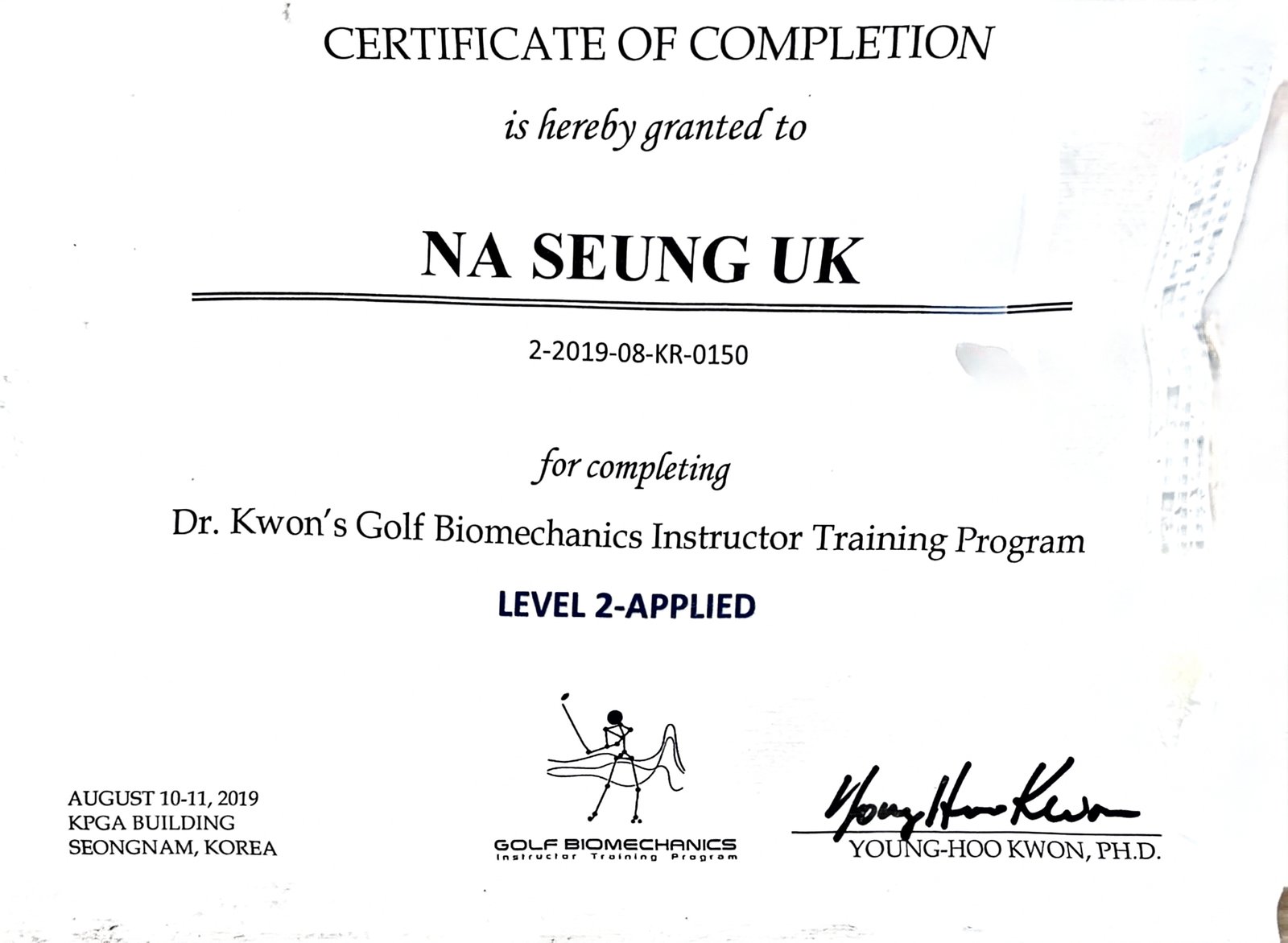
Dr. Young-Hoo Kwon is the director of the Biomechanics & Motor Behavior Laboratory at Texas Woman's University and the developer of Kwon3D, and has studied the biomechanics of the golf swing. Na Seung Uk began Dr. Kwon's Golf Biomechanics training in 2014 and went on to complete the Instructor Training Program Level 2-Applied (No. 2-2019-08-KR-0150) on 2019.08.10–11. Detailed completion records are at coaching lineage and certificates (Lineage).
Ground reaction force coaching in the press
JoongAng Ilbo's 2026 long-hitting and speed series ③ "'Thrusting Your Hips Can Rupture a Disc': 4 Common Mistakes in Ground-Reaction-Force Swings" introduced coach Na Seung Uk's view on ground reaction force coaching. Other TV and press records are at TV and press (Media). The full distance program, including ground reaction force, is run in golf distance lessons.
Frequently asked questions
Is ground reaction force pushing hard into the ground?
Do I need to use my lower body first to gain distance?
Should I keep my center fixed in the backswing?
Can video alone tell me my ground reaction force?
Do teaching pros need to study biomechanics too?
- Written by Na Seung Uk · MYONEGOLF · Golf Digest Korea Best Teachers in Korea 2022–2023
- Related — Coaching lineage and certificates
- Related — How to increase driver distance
- Related — Golf swing speed training
- Related — Golf distance lessons
- Related — TV and press records